Stack Inspection
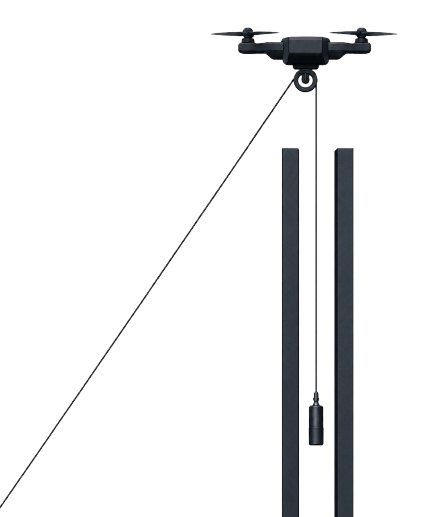
Drone Lyne enables cameras, sensors and specialist payloads to be deployed into industrial stacks and chimneys while the drone remains positioned above the stack opening and outside the flue gas stream.
Current Inspection Methods
Hot Camera Systems
High temperature camera lowered from the top of an operating stack.
Advantages
- Inspect while stack remains online
- Stable crane deployment
- Camera diameter tailored to stack
Limitations
- Work at height to install equipment
- Personnel exposure to hazardous gases
- Lifting equipment may load the stack structure
- Scaffolding or specialist access may be required
- High mobilisation time and cost
Internal Inspection Drone
Drone flown inside the chimney carrying onboard cameras and sensors.
Advantages
- Eliminates work at height
- Can carry a variety of sensors or probes
- Rapid deployment compared with rope access
Limitations
- Typically limited to larger, unrestricted flues
- Offline, cooled stacks only
- Poor wireless signal quality inside stack
- Propeller wash can disturb dust and soot
- Limited recovery options if drone is stuck
By positioning a passive drone above the stack, Drone Lyne combines online inspections with rapid drone deployment.
Drone Lyne Stack Inspections
ADVANTAGES
Drone Lyne Benefits
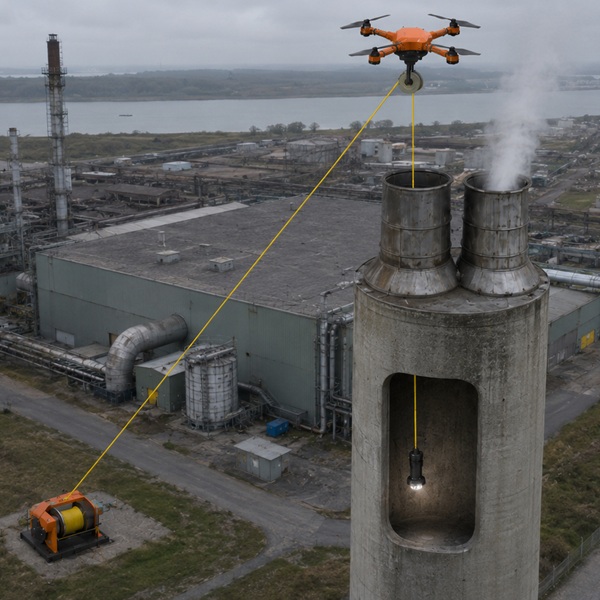
Drone Lyne is being developed as a third approach that combines rapid aerial positioning with controlled payload deployment from the ground.
Personnel Safety
- No work at height
- No exposure to hazardous gases
- Ground-based operation
- Reduced confined-space access
Rapid Deployment
- Quick mobilisation
- Minimal access equipment
- Reduced shutdown time
- Faster inspections
Online Inspection
- Inspect operating stacks
- Monitor live processes
- Pre-shutdown assessment
- Earlier fault detection
Modular Payloads
- Cameras, thermal, LiDAR, gas sensors, temperature probes
- Interchangeable equipment
- Combine multiple sensors
- Future sensor compatibility
Tailored Access
- Payload diameter matched to the stack
- Pass through narrow restrictions
- Suitable for varied geometries
- Sensor selected for the task
Passive Drone Operation
- Drone remains outside the stack
- Avoids heat, dust and confined spaces
- Not affected by GPS-denied flight inside the chimney
- Reduced pilot workload
Stable Inspection
- Ground-controlled depth
- No propeller wash on the inspection area
- Doesn't disturb soot or dust
- Repeatable inspection positioning
Operational Resilience
- Multiple contingency options
- Recover or release payload if required
- Independent deployment system
- Inspired by proven oil and gas wireline operations
Same Drone, Different Sensors
Whether inspecting an operating stack or conducting a detailed shutdown assessment, Drone Lyne can deploy a range of interchangeable payloads selected for the inspection objective. The same deployment platform supports multiple sensors, allowing inspection equipment to evolve without changing the overall system.
Online Inspection
During operation, compatible payloads can measure process conditions inside the chimney while each sensor output is logged against deployment depth measured from the winch. This creates a depth-referenced profile of temperature, pressure, gas composition or visual condition through the stack.
Offline Inspection
After shutdown and cooling, higher-resolution payloads can be deployed for detailed internal assessment. Images, point clouds and inspection readings can be linked to measured depth inside the chimney, helping teams compare defects, geometry and condition over repeated inspections.
Drone Lyne in Action
Every stack presents different inspection challenges. By combining interchangeable payloads with rapid deployment, Drone Lyne can be configured for a wide range of inspection objectives. The examples below illustrate how the platform could support asset owners before, during and after planned shutdowns.
Locate a Problem While Online
Locate a Problem While Online
When plant data indicates abnormal draft conditions, unexpected oxygen levels or unusual temperatures, Drone Lyne can deploy multiple sensors into an operating stack to identify where conditions change.
Temperature, pressure and gas measurements are recorded against depth to pinpoint anomalies. For example, a local increase in oxygen combined with falling gas temperature may indicate air ingress through a damaged liner or failed joint. A high-temperature camera can then inspect that location for visible defects, deposits or corrosion.
By combining several measurements, engineers can distinguish local stack defects from wider process issues, helping define inspection priorities before a planned shutdown.
Monitor Changing Stack Conditions
Monitor Changing Stack Conditions
Stack conditions evolve as fuel composition, production rate, combustion settings and upstream treatment systems change. Measurements taken only at the stack outlet cannot reveal how conditions vary throughout the chimney.
Drone Lyne can repeat the same internal survey at regular intervals, building comparable temperature and pressure profiles over time. These measurements can identify gradual changes in heat loss, draft performance or where the liner approaches the calculated acid dew point.
Repeating surveys at different production rates also helps engineers understand how stack conditions change with plant output and identify deterioration before significant corrosion develops.
Map Internal Geometry While Offline
Map Internal Geometry While Offline
Once the stack has cooled, Drone Lyne can deploy a LiDAR scanner to create a detailed three-dimensional model of the internal liner without requiring full-height scaffolding or an immediate man-riding inspection.
The scan can measure internal diameter, ovalisation, buckling, offsets between liner sections and other geometric changes. It can also identify deposits, displaced material and partial obstructions affecting gas flow.
Comparing repeat scans over time highlights changes in the internal profile and identifies areas requiring closer visual inspection or targeted NDT, supporting maintenance planning and future repairs.
Inspect a Structurally Unsafe Chimney
Inspect a Structurally Unsafe Chimney
A chimney suspected of structural instability may be unsafe for man-riding, rope access or installing temporary equipment. Conventional inspection drones may also be unsuitable where internal diameters are restricted or damaged components present collision risks.
Drone Lyne keeps the drone safely outside the chimney while lowering a camera or LiDAR payload into the structure. This reduces equipment inside the stack and avoids exposing personnel before the chimney's condition is understood.
If the payload becomes stuck inside the chimney, the line can be released so the drone can return and land safely.
The resulting imagery and geometric model can help structural engineers assess buckling, displaced liner sections, cracking and fallen material, identifying where further investigation or stabilisation may be required.
Build and Update a Digital Twin
Build and Update a Digital Twin
Drone Lyne can collect spatially referenced data to create, validate and update a digital twin of both the chimney's physical condition and its operating behaviour.
During normal operation, temperature, pressure and gas-composition measurements can be recorded at multiple production rates to understand how thermal and flow conditions change with plant output. Following shutdown, LiDAR and visual surveys can capture the internal geometry, including changes in diameter, ovalisation, buckling, deposits and other structural features.
Combining these online and offline datasets provides engineers with a richer understanding of stack performance, supports thermal and gas-flow modelling, identifies areas at risk of condensation or corrosion, and allows the digital twin to evolve alongside the asset throughout its operational life.
Discuss Stack Inspection
We are developing the next generation of industrial stack inspection and are working with asset owners, inspection specialists and industrial operators to explore new applications. If you have a challenging access problem or a specialist sensor to deploy, we'd love to discuss how Drone Lyne could help and share demonstrations of our latest prototype.
Contact Us